
Hydroponic Troubleshooting
Why Hydroponic pH Keeps Rising: Causes and a Diagnostic Checklist
Find out why hydroponic pH keeps rising, how to separate alkalinity from normal system change, and what to verify before adding more pH down.
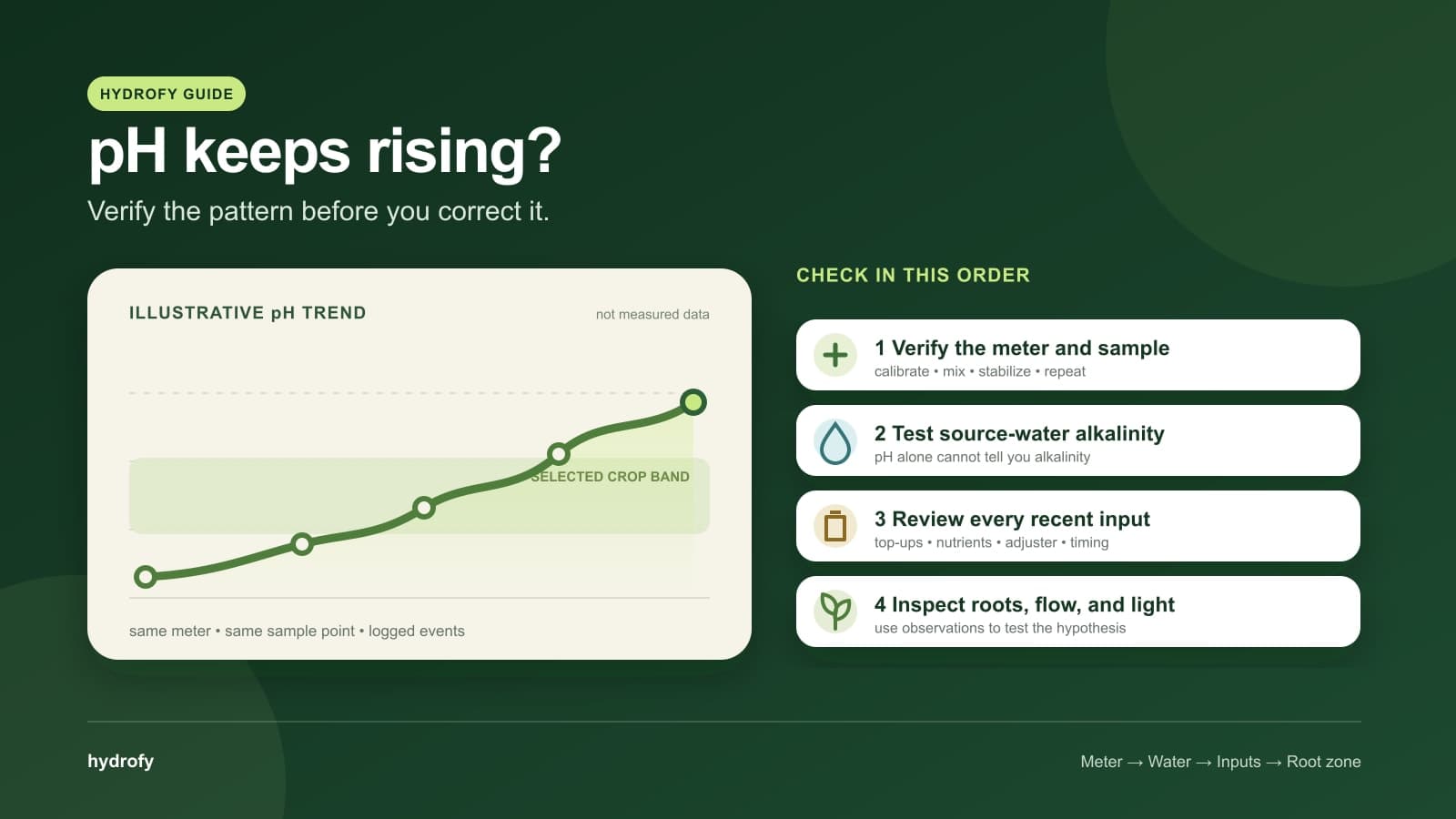
The short answer
Hydroponic pH can keep rising because source-water alkalinity neutralizes acid, plants and microbes change solution chemistry, repeated top-ups change the reservoir, or the reading is distorted by calibration, mixing, temperature, or sample-location differences. Rising pH is a symptom, not a diagnosis. Repeat the reading with a calibrated meter after the solution is fully mixed, then compare pH with recent EC, water level, temperature, and inputs. Test source-water alkalinity rather than judging it from pH alone. Inspect roots, circulation, light entering the solution, and anything recently added. Correct only after one explanation fits the evidence; avoid repeatedly adding pH down to an unexplained reservoir.
Key takeaways
- • High source-water pH and high alkalinity are not the same. Alkalinity measures acid-neutralizing capacity and requires a separate test; it is often the first water-quality variable to investigate when pH rebounds after correction.
- • Do not diagnose from pH alone. Read pH beside EC or clearly labelled TDS, water level, temperature, solution age, top-ups, nutrient additions, pH-adjuster additions, and root or equipment observations.
- • Confirm the measurement before changing the reservoir: calibrate as directed, sample from the same place, mix the solution, let the probe stabilize, and repeat a surprising result.
- • Plant nutrient uptake can move solution pH, but direction and size depend on crop, growth stage, nutrient formulation, biology, and system conditions. Do not reformulate nitrogen from a generic rule found online.
- • A stable EC does not prove that individual nutrients remain balanced. EC measures combined conductivity, so persistent drift or plant symptoms may justify fresh solution, water analysis, or qualified crop advice.
- • Hydrofy can organize manual pH and EC or TDS entries, notes, timestamps, reminders, and weekly trend views. It does not turn a pH pattern into a chemical diagnosis or make an adjustment safe.
Treat rising pH as a pattern to diagnose
When a hydroponic reservoir moves from its selected pH range toward a higher number, the most tempting response is another dose of pH down. That may change the reading, but it does not establish why the number rose. If the meter, water, nutrient solution, plants, and recent actions are all possible contributors, a correction made before verification can hide the useful evidence and add another variable to the system.
Begin by defining the pattern in plain language. Did pH climb gradually across several comparable daily readings, jump immediately after a top-up, rebound after an acid adjustment, or appear different only when sampled at another location? Is EC rising, falling, or roughly level? Is reservoir volume falling normally, dropping unusually fast, or being topped up repeatedly? A sentence such as “pH rose after each tap-water top-up while EC and volume were logged” is much more diagnostic than “the pH is bad.”
There is no universal daily pH-rise number that separates healthy from unhealthy systems. A small bucket, a large recirculating reservoir, a media-based drip system, and a commercial raft system do not have the same water volume, crop demand, buffering, fertilizer, or sampling geometry. Use the operating band selected for the crop and system, the rate of change in your own comparable records, and the condition of plants and roots. The goal is an explainable, manageable trend—not a perfectly flat line.
pH is not alkalinity
This distinction solves many confusing cases. pH is the acidity or basicity measured at one moment. Alkalinity is the water's capacity to neutralize acid, influenced largely by bicarbonates and carbonates. Missouri Extension emphasizes that the two do not directly correlate: water can have a high pH without high alkalinity, or meaningful alkalinity without an unusually high pH. A pH meter cannot measure alkalinity; a titration or suitable laboratory water analysis is needed.
Oklahoma State University Extension states that high-alkalinity water can increase nutrient-solution pH and calls for more frequent checking when it is used. Missouri Extension explains the practical consequence from the other direction: more acid is required to change high-alkalinity water, while very low alkalinity can allow pH to change easily. Therefore, a reservoir that repeatedly rebounds after measured correction makes source-water alkalinity a reasonable hypothesis, not a conclusion. Confirm it with a test before choosing a water-treatment strategy.
First check whether the rise is real
A false or poorly comparable trend is the safest cause to eliminate first. Rinse and store the probe exactly as its manufacturer directs. Calibrate with in-date standards on the meter's schedule; Missouri Extension gives weekly two-point pH calibration at pH 4 and pH 7 as a practical standard for handheld meters. If a probe responds slowly, will not calibrate, has dried out, or gives an unexpected value in a known standard, resolve that problem before dosing the reservoir.
Next, make the sample repeatable. Circulate or mix the solution, but do not sample directly beside a recent nutrient or pH-adjuster addition. Use the same reservoir location and roughly the same time of day. Let the probe stabilize. Record solution temperature and use the meter as instructed. Automatic temperature compensation can help the instrument report conductivity consistently, but it does not make two reservoirs at different temperatures biologically identical.
- • Write down the meter model, displayed unit, calibration date, standards used, and any error message.
- • Keep pH, EC, and TDS distinct. If a meter reports ppm, record its conversion scale or model so later comparisons use the same convention.
- • Label the sample point: main tank, return line, channel, bucket, input solution, or drainage. Do not merge unlike locations into one trend.
- • Repeat a surprising reading after mixing before adding anything. Record both readings if the discrepancy itself may matter.
Rank the likely causes of hydroponic pH rise
Once the readings are credible, work from documented system events toward more complex explanations. Several causes can occur together. High-alkalinity top-up water can resist acid while plants are also changing ion balance and a small reservoir is losing water. A diagnosis should explain timing as well as direction: what changed immediately before the rise, and what other measurements moved with it?
1. Source water and repeated top-ups
Measure source water separately from the finished nutrient solution and retain its baseline. Check pH and EC, but request alkalinity and relevant ion results when pH is persistently difficult to manage. A high source-water pH alone does not prove a strong buffering load. Conversely, a source that appears acceptable on a pH meter may still carry enough bicarbonate or carbonate to influence the reservoir after repeated additions.
Look at timing. If the reservoir rises after nearly every top-up, record the top-up volume and test the incoming water before it enters the system. If the rise happens even when no source water was added, alkalinity may still matter because it is already in the solution, but the immediate trigger lies elsewhere. Do not assume reverse osmosis is automatically required. Treatment or blending changes the mineral contribution and operating cost, so base that decision on a water report and a validated nutrient plan.
2. Plant uptake, nutrient form, and biology
Plants do not take up water and every dissolved ion at identical rates. Their charge balance and the nitrogen forms in the nutrient solution can shift root-zone acidity. University of Florida IFAS explains that nitrate uptake can increase solution pH and that rapid pH change is more prevalent in hydroponics and rockwool than in more buffered solid media. That mechanism helps explain one possible direction; it is not a universal home dosing recipe.
For a home grower, the safe inference is modest: if pH rises while plants are actively growing and the reading is verified, uptake may be part of the pattern. Do not respond by adding an ammonium fertilizer or changing a two-part formula from an internet rule. Nitrogen form affects nutrition as well as pH, and inappropriate ammonium can harm plants. Keep using the validated crop recipe or manufacturer program, and seek crop-specific expertise before reformulating it.
Microbial and root-zone processes can also move pH, but pH direction alone does not identify a healthy microbial community or root disease. Inspect roots for changes in color, firmness, odor, and growth; check water temperature, flow, and aeration. Record what you see. Treat root symptoms as a separate diagnosis that needs appropriate sanitation and crop guidance rather than using a pH graph as a disease test.
3. Solution age, concentration, and accumulated inputs
Every top-up and correction changes the reservoir history. Plants remove water and nutrients at different rates, evaporation removes water but leaves dissolved ions behind, and replacement water adds its own ions. Oklahoma State notes that nutrient ratios can move beyond their intended limits over time. EC can show that total conductivity changed, but Missouri Extension cautions that an on-target EC does not prove individual nutrients remain balanced.
Review the cumulative record: starting volume, top-up volumes, nutrient additions, pH-adjuster additions, EC direction, and days since a complete change. If the solution has been repeatedly patched and the composition is no longer knowable, a correctly prepared fresh solution may be more defensible than another adjustment. Replacement timing varies by tank size, crop, recirculation, water quality, and operating procedure; one generic calendar rule cannot settle every case.
4. Root-zone, media, and system differences
The main tank is not always the root zone. Poor circulation, blocked channels, uneven irrigation, or sampling from a return line can produce readings that differ by location. In a media-based system, the substrate can also interact with the solution. Missouri Extension describes methods for measuring root-zone pH and EC and notes that organic-based media can behave differently from inert media. Follow a sampling method suited to the system instead of assuming one tank reading represents every root.
Inspect new media, recently cleaned parts, dosing lines, and anything that entered the water before the pattern began. The fact that an item is new does not prove it raises pH, and a connector's material name does not establish chemical compatibility. Use the component maker's preparation and compatibility instructions. If the pH step began immediately after a known addition or equipment change, isolate and verify that event before changing the fertilizer program.
5. Light exposure and algae as system clues
University of New Hampshire Extension recommends excluding light from nutrient solution where possible and cleaning components between crops because hydroponic water, nutrients, and light support algae. Visible algae signals that light is reaching the solution and that the system needs inspection. However, algae is not proven as the cause of a particular pH rise merely because both are present. Record when the change occurs, inspect covers and openings, and correct light leaks as a maintenance issue without skipping the water and meter checks.
Use pH, EC, and water level as a diagnostic matrix
The combinations below are hypotheses to test, not automatic commands. EC measures total conductivity; it cannot name the ions that changed. Water-level estimates may also be imprecise. Use the matrix to choose the next observation that can disprove an explanation. If a pattern does not repeat under comparable sampling, return to measurement quality before escalating the intervention.
pH rises while EC and water level fall
Active plant uptake may contribute when both water and conductive ions are being removed, but this combination does not prove that plants are “feeding perfectly.” Verify the recipe, crop stage, temperature, and root condition. Check whether plain-water top-ups occurred. Continue comparable measurements before changing nutrient ratios; EC cannot show whether one essential ion is depleted while another remains.
pH and EC rise while water level falls
Concentration from water loss or repeated inputs becomes a strong question, because dissolved ions remain when water leaves through evaporation. Verify the reservoir volume and source-water EC, review what was added, and check temperature and ventilation. The pH cause may still be alkalinity or biology, so do not assume dilution answers the full problem. Compare with a correctly mixed fresh-solution baseline.
pH rises after each top-up
Test the incoming water's pH, EC, and alkalinity and record top-up volume. Fully mix before remeasuring. A repeatable step after the same source-water addition supports a water-quality investigation. It does not establish the required acid dose; alkalinity, total volume, crop recipe, and the specific adjustment product all affect that calculation.
pH falls after pH down, then rebounds
First ask whether the solution was mixed and allowed to stabilize. Then examine alkalinity and the total adjustment history. An immediate local reading beside the dose can look successful before the tank equilibrates. A consistent rebound in a well-mixed reservoir can fit buffering by alkalinity, but it still needs a water test. Repeatedly adding acid without tracking the amount can alter nutrient inputs and increase handling risk.
pH jumps while EC, volume, and system events do not explain it
Prioritize calibration, probe condition, sample location, mixing, temperature, and contamination between samples. Jagged numbers without matching system events often provide less evidence for a biological diagnosis than for a measurement problem. Confirm in standards and repeat under a fixed method before acting.
A safe response sequence before adding more pH down
Use the following sequence whenever the rise is surprising or persistent. It is deliberately conservative because concentrated pH adjusters can be hazardous and because every addition changes the nutrient solution. For commercial dosing equipment or significant acid treatment, follow a documented procedure and use qualified help.
- • Pause nonessential additions. Write down the last verified pH, EC, temperature, volume, and every input since then.
- • Check the meter in the correct standards, rinse it as directed, and repeat the reservoir reading after full mixing at the usual sample point.
- • Measure the source water separately. Obtain alkalinity and relevant ion results if they are unknown; do not infer alkalinity from pH.
- • Inspect reservoir level, roots, flow, aeration, dosing or return lines, light leaks, residue, and recently introduced media or components.
- • Compare pH direction with EC or labelled TDS, water level, temperature, crop stage, and top-up history. Choose the leading hypothesis and a check that could falsify it.
- • If a correction is supported, use the product label and established crop procedure. Add incrementally, mix, wait, and remeasure. Never mix concentrated acids and bases or improvise a scaled commercial dose.
- • If the solution history is uncertain, symptoms persist, or corrections keep accumulating, consider a properly mixed replacement and qualified water or crop analysis instead of continuing to patch it.
Set nutrient concentration before the final pH adjustment
For a fresh reservoir, Oklahoma State recommends adding fertilizer, mixing, setting EC, and then adjusting pH. This order matters because fertilizer changes both conductivity and pH. Use the manufacturer recommendation or a validated crop recipe, not EC alone, to decide which nutrients and proportions belong in the solution. Once mixed, allow the meter to stabilize before the final pH decision.
Do not lower pH far below the crop range in anticipation of a rebound. That exposes roots to an unnecessary extreme and assumes the future rate is predictable. Work inside a crop-appropriate operating band and make the smallest measured change supported by the procedure. If the reservoir will not remain manageable, diagnose the water and solution design rather than increasing correction size by guesswork.
Build a short diagnostic log that preserves cause and effect
A useful troubleshooting record does not need a fabricated “ideal” graph. It needs comparable observations. For at least several normal check cycles, use the same meter, sample point, and approximate time. Record before changing anything, then record the action and a post-mixing value when the product instructions and system procedure make that appropriate. If the system is unsafe or plants are deteriorating rapidly, do not delay necessary qualified help merely to complete a log.
- • Date and time; system; crop and stage; sample point; meter and displayed unit.
- • pH; EC in mS/cm or clearly labelled TDS/ppm scale; water temperature; approximate reservoir level or measured volume.
- • Source-water pH and EC when a top-up occurs; top-up volume; known alkalinity result and test date when available.
- • Nutrient, water, pH-adjuster, cleaner, or other input; exact product; amount; reason; and whether the solution had fully mixed before the next reading.
- • Root appearance and odor; visible algae or light entry; pump, flow, aeration, leaks, and environmental changes.
- • Decision: observe, verify meter, test water, correct under procedure, replace solution, or ask for qualified help.
Track rising pH in Hydrofy without overstating the app
Hydrofy can keep the diagnostic context together. In the current committed app model, a log belongs to a hydroponic system and can also be associated with a plant. The log types include pH, EC, TDS/PPM, water temperature, reservoir level, pH and EC adjustments, nutrient additions, water changes, calibration, equipment checks, root inspections, and general observations. Entries support timestamps, units, values, and notes, with manual entry as the default data source.
For this problem, create comparable pH entries and pair them with EC or explicitly labelled TDS, water temperature, and reservoir-level records. Put source-water results, top-up volume, recent inputs, meter calibration, and root observations in the notes or corresponding log types. The current measurement view supports precise manual entry and shows the last recorded value as a reference, which helps catch a typing error before it becomes a false trend.
Use the system analytics view to inspect pH and EC trends; its initial period is one week. A week can reveal whether the apparent rise repeats after the same event, while individual timestamps preserve the sequence. Set pH-check or EC-check reminders if a consistent check is easy to forget, and record completion rather than assuming it happened. Keep different reservoirs in their own system histories.
Hydrofy organizes evidence; it does not identify alkalinity from a pH value, analyze individual nutrients from EC, confirm root disease, or calculate a universally safe chemical dose. The App Store listing documents optional integrations, but connection behavior depends on the app version, service, device, and configuration. Do not describe a manual log as a live sensor reading unless a supported integration has actually been configured and verified for that system.
What not to do when hydroponic pH keeps rising
- • Do not keep adding pH down without recording the product, amount, timing, reservoir volume, and response after mixing.
- • Do not call high source-water pH “high alkalinity” without an alkalinity result.
- • Do not change nitrogen forms, fertilizer ratios, or crop EC targets solely to flatten a pH chart.
- • Do not assume a normal-looking EC proves that each essential nutrient remains correctly proportioned.
- • Do not combine readings from different systems, sample locations, meters, temperatures, or TDS scales into one trend.
- • Do not diagnose root disease, healthy feeding, or algae-driven pH change from direction alone.
- • Do not use household acids, bases, or treatment recipes simply because a forum calls them safe. Follow products intended and labelled for the use, including handling and protective-equipment directions.
- • Do not expose roots to an intentionally extreme starting pH because you expect it to drift back later.
Rising hydroponic pH decision checklist
Finish with a decision that matches the evidence. Observe when the reading is verified, inside the selected crop band, and moving at a manageable, explainable rate. Investigate when pH repeatedly leaves the band, rebounds after correction, changes without a matching event, or differs by sample point. Replace or escalate when the solution history is no longer knowable, the meter cannot be validated, roots or plants show persistent symptoms, or chemical handling and water treatment exceed your procedure or experience.
- • Is the crop-specific target documented, and is the current value actually outside it?
- • Was the meter calibrated and the fully mixed solution sampled consistently?
- • What did EC, temperature, and water level do during the same interval?
- • What water, nutrients, pH adjuster, cleaner, media, or equipment entered the system?
- • Do you have a current alkalinity result, not just a source-water pH reading?
- • Are roots, flow, aeration, reservoir covers, and light exclusion normal?
- • Can one leading explanation account for both the timing and the related measurements?
- • Is the proposed action supported by the crop plan, product label, and meter or equipment instructions?
Frequently asked questions
Is it normal for pH to rise in hydroponics?
Some movement is expected because plants, microbes, water additions, and nutrient chemistry change a working solution. Rising pH is not automatically harmless or harmful. Compare it with the crop-specific operating band, verified meter readings, EC, water level, temperature, solution history, and root condition. There is no universal safe daily drift rate for every crop and system.
Why does my hydroponic pH rise again after adding pH down?
First confirm that the tank was fully mixed and the meter stabilized. A repeatable rebound can be consistent with source-water alkalinity neutralizing added acid, but pH alone cannot confirm alkalinity. Test the water, review reservoir volume and total additions, and follow the adjustment product's label. Repeated unlogged doses make the solution harder to interpret.
Does high tap-water pH mean high alkalinity?
No. Missouri Extension explains that pH and alkalinity do not directly correlate. pH is a momentary acidity/basicity reading; alkalinity is acid-neutralizing capacity. A pH meter cannot measure alkalinity. Request an appropriate water analysis or titration result before treating alkalinity as the cause.
Should I use reverse-osmosis water if pH keeps rising?
Not automatically. Oklahoma State lists reverse osmosis as one way to reduce alkalinity, but changing water also changes calcium, magnesium, other ions, waste-water volume, and the nutrient recipe you need. Start with a water analysis and use qualified, crop-specific guidance before investing in treatment or changing formulation.
Can EC tell me why pH is rising?
EC adds useful context but cannot identify the cause by itself. It measures total conductivity, not individual nutrient balance. A falling, rising, or stable EC can narrow the next check when read with volume, inputs, crop stage, and roots, but none of those patterns is an automatic dosing instruction.
How can I use Hydrofy to troubleshoot pH drift?
Record pH, EC or labelled TDS, water temperature, reservoir level, adjustments, water changes, calibration, and observations in the correct system history. Keep the sample method consistent, add notes for top-ups and root or equipment checks, review the weekly pH and EC trends, and use reminders for repeat checks. Hydrofy preserves the sequence; it does not replace a calibrated meter, water test, or qualified diagnosis.
Sources and further reading
- University of Missouri Extension — Hydroponic Nutrient Solutions (G6984) — Primary reference for the pH-versus-alkalinity distinction, water testing, limits of EC, nutrient-solution change over time, meter calibration, and root-zone sampling.
- Oklahoma State University Extension — Electrical Conductivity and pH Guide for Hydroponics — Primary reference for high-alkalinity water and rising solution pH, water analysis, mixing and measurement order, EC interpretation, and solution management.
- University of New Hampshire Extension — Hydroponics at Home — Primary reference for home-system scope, water and nutrient uptake, variation in solution-change needs, root-zone oxygen, and excluding light from nutrient solution.
- University of Florida IFAS Extension — Fertilizer Management for Greenhouse Vegetables (CV265) — Primary reference for nitrate uptake increasing solution pH, lower buffering in hydroponic and rockwool systems, water analysis, and periodic solution management.